
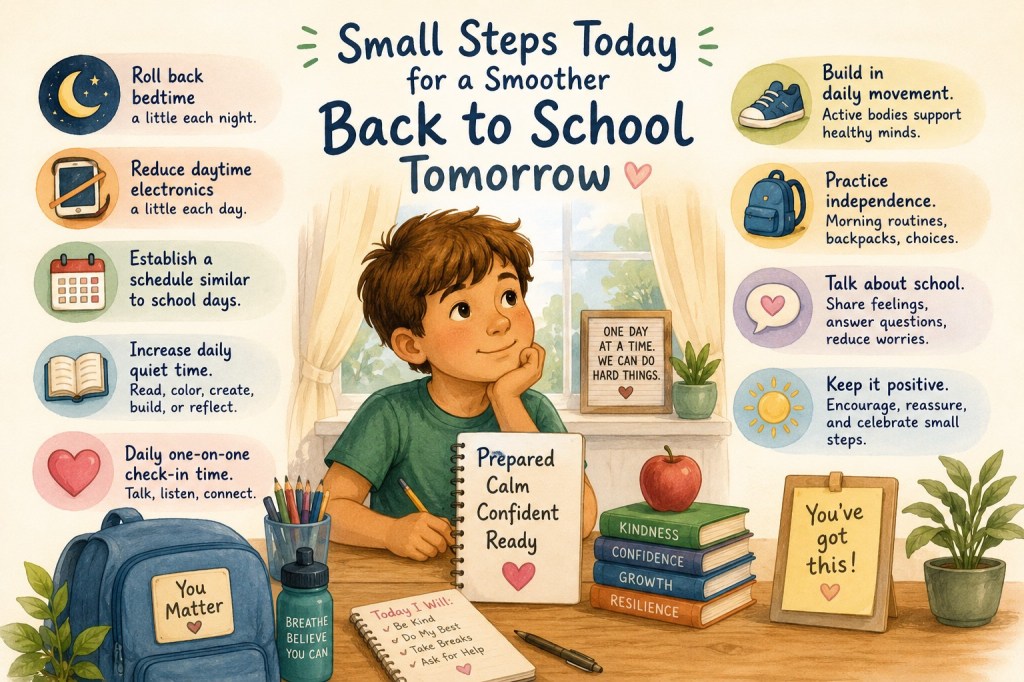
The final weeks of summer can bring mixed emotions for families. Some children are excited to see friends and return to familiar routines, while others may feel anxious, irritable, overwhelmed, or simply resistant to giving up the freedom of summer.
One of the best things parents can do is begin the transition before the first day of school.
Children’s brains and bodies adjust more easily when changes happen gradually. Rather than switching overnight from late bedtimes, unlimited screen time, and flexible summer days to early mornings, structured classrooms, and homework, parents can use the weeks before school to slowly recreate some of the rhythms children will experience once classes begin.
Here are several ways to make that transition easier.
1. Start Rolling Back Bedtime
Summer often means later nights and later mornings. Unfortunately, waking a child several hours earlier on the first day of school doesn’t automatically reset their internal clock.
Begin gradually moving bedtime and wake-up time earlier. Depending on how different your child’s summer schedule has become, consider shifting bedtime and wake time by about 15–30 minutes every few days until you are close to the schedule they will need for school.
Try to keep the morning wake-up time relatively consistent as well. Sleeping until noon one day and waking at 8:00 the next makes it harder for the body to develop a predictable sleep-wake rhythm.
A calming nighttime routine can also help. Dim lights, quieter activities, reading, bathing, stretching, or listening to calming music can begin signaling to the brain that the day is ending.
2. Gradually Reduce Daytime Electronics
For many children, summer includes considerably more time on phones, tablets, video games, television, and computers.
Going from several hours of daytime electronics to suddenly having none during a six-hour school day can feel like a major adjustment.
Instead, begin decreasing recreational electronics a little each day.
As school approaches, work toward having little or no recreational screen time during school-day hours. This allows children to become accustomed to finding other ways to manage boredom, entertain themselves, and tolerate periods when immediate digital stimulation isn’t available.
Evening electronics can also be gradually reduced, especially close to bedtime.
The goal doesn’t have to be eliminating technology altogether. It is helping the brain adjust from the rapid, highly stimulating environment of screens to the slower pace of activities such as listening, reading, writing, talking, and sitting in a classroom.
3. Begin Following a School-Day Schedule
A predictable routine helps children feel more secure because they know what is coming next.
During the final couple of weeks before school, begin structuring the day more like a school day.
That might include:
- Waking up around the time they will wake for school
- Getting dressed rather than staying in pajamas
- Eating breakfast at approximately the same time
- Having lunch around the time they will eat at school
- Scheduling active play or movement similar to recess
- Creating periods for quiet activities
- Establishing a consistent evening routine
- Returning to a school-year bedtime
You don’t need to recreate school at home. Summer should still feel like summer. The goal is simply to give the brain some predictable anchors throughout the day.
4. Rebuild Their “Sitting Still” Muscles
Many children spend summer moving freely from one activity to another. When school begins, they suddenly need to sit, listen, follow directions, complete assignments, and tolerate activities that may not always be their first choice.
That takes practice.
Begin introducing daily quiet time and gradually increase how long it lasts based on your child’s age and developmental level.
Quiet-time activities might include:
- Reading
- Coloring
- Drawing
- Puzzles
- Legos or building activities
- Journaling
- Crafts
- Painting
- Workbooks
- Audiobooks while drawing or building
- Independent imaginative play
Start where your child can be successful. For a younger child, that might initially be 10–15 minutes. Older children may be able to begin with longer periods.
Gradually increasing the time helps strengthen attention, patience, frustration tolerance, and the ability to stay engaged without constant stimulation.
5. Bring Back Regular Reading
If reading hasn’t been part of your child’s summer routine, begin introducing it again before school starts.
Even 15–30 minutes of daily reading can help children get accustomed to focusing on written material again.
For children who dislike reading, let them choose the material whenever possible. Graphic novels, magazines, joke books, sports books, comics, biographies, or books about favorite interests all count.
The goal is not to turn the final weeks of summer into homework. The goal is to help the child’s brain shift back into a learning mindset.
6. Build in Daily Movement
Children aren’t designed to sit all day.
Physical activity helps with attention, emotional regulation, sleep, stress management, and overall mental health.
Try to include movement every day, particularly before asking children to engage in longer quiet activities.
This might include bike riding, swimming, walking the dog, playing at the park, dancing, sports, trampoline time, hiking, or simply playing outside.
For some children, especially those who struggle with attention or hyperactivity, movement before a quiet activity can make it significantly easier to focus afterward.
7. Start Practicing Morning Independence
School mornings can become stressful quickly when everyone is trying to get out the door.
Before school begins, practice some of the tasks your child will need to manage independently.
Depending on their age, this might include:
- Getting dressed
- Brushing teeth
- Packing a backpack
- Filling a water bottle
- Putting shoes on
- Remembering lunch or school supplies
- Checking a simple morning checklist
The more familiar these tasks become, the less parents have to remind, rush, and negotiate once school begins.
8. Have a Daily One-on-One Check-In
One of the most valuable back-to-school routines has nothing to do with academics.
Set aside a few minutes each day for individual check-in time with each child.
Try to make this different from asking, “How was your day?” which often receives the predictable response: “Fine.”
Instead, try questions such as:
“What was the best part of today?”
“Was anything hard today?”
“What did you think about a lot today?”
“Did anything make you nervous?”
“What are you looking forward to tomorrow?”
“Is there anything you wish adults understood about your day?”
Children are more likely to share concerns when conversation is already part of the family routine rather than something that suddenly happens when a problem arises.
One-on-one time can also be particularly important in families with multiple children. Even ten uninterrupted minutes can communicate, You have my full attention. What is happening in your world matters to me.
9. Start Talking About School Before School Starts
Some children will eagerly talk about school. Others won’t.
Don’t assume a child isn’t worried simply because they aren’t talking about it.
Bring school into conversations casually.
Ask what they are looking forward to, what they think will be different, who they hope will be in their class, or whether there is anything they’re wondering about.
For younger children, visiting the school, walking past the building, looking at pictures of the classroom, or practicing the drive to school can reduce uncertainty.
For older children, talk about schedules, extracurricular activities, friendships, workload, transportation, and expectations.
Whenever possible, replace unknowns with information. Predictability can significantly reduce anxiety.
10. Avoid Overscheduling the First Few Weeks
Parents are often eager to restart sports, clubs, lessons, activities, and social commitments when school begins.
Remember that returning to school is already a major transition.
Children may be mentally exhausted during the first few weeks, even when they enjoy school.
Whenever possible, leave some breathing room in the family schedule. Protect downtime after school and avoid interpreting temporary irritability or tiredness as misbehavior.
Some children hold themselves together all day and release their emotions once they return to the place where they feel safest.
11. Create a Calm After-School Routine
Instead of immediately asking about homework, grades, or missing assignments, consider giving children a short decompression period after school.
They may need a snack, movement, quiet time, conversation, or simply time alone.
Some children want to tell you everything that happened the moment they walk through the door. Others need 30 minutes before they’re ready to talk.
Pay attention to what works for your child.
12. Talk About Worries Without Trying to Talk Them Out of Them
If your child says, “I’m scared about school,” it can be tempting to respond:
“There’s nothing to worry about.”
We usually say this because we want children to feel better. But to an anxious child, it may sound like, You shouldn’t feel this way.
Instead, acknowledge the feeling while communicating confidence.
You might say:
“It makes sense to feel nervous when you don’t know exactly what school will be like yet. We’ll figure it out together.”
Children don’t necessarily need parents to remove every uncomfortable feeling. They need to learn that uncomfortable feelings can be experienced, talked about, and managed.
13. Watch for Signs That Back-to-School Anxiety May Need Additional Support
Some nervousness before school is completely normal.
Consider reaching out to a school counselor, pediatrician, or mental health professional if anxiety begins significantly interfering with your child’s daily life.
Possible signs include:
- Frequent stomachaches or headaches without an identified medical cause
- Difficulty sleeping
- Panic symptoms
- Intense emotional outbursts
- Persistent sadness or irritability
- Refusing to attend school
- Excessive reassurance seeking
- Significant changes in appetite
- Withdrawal from friends or activities
- Repeated statements that something bad will happen at school
Early support can prevent anxiety from becoming more entrenched.
Progress, Not Perfection
Preparing children for the return to school doesn’t require turning August into a miniature school semester.
Think of it as gradually helping the brain change gears.
Move bedtime a little earlier. Reduce screens a little each day. Bring back predictable routines. Practice quiet activities. Encourage movement. Create opportunities for independence. And perhaps most importantly, make time every day to ask your child how they’re doing—and really listen to the answer.
Children don’t need to arrive at school perfectly prepared.
They need routines that help their bodies adjust, opportunities to practice skills they haven’t used as much over the summer, and the reassurance that the adults in their lives are available when the transition feels difficult.
A little preparation now can make those first weeks of school feel much more manageable—for children and their parents.

